

The Researcher’s Edge: How to Write a Literature Review Ethically Using AI Tools with 10x Speed
Writing a literature review used to be a rite of passage involving dusty library stacks, hundreds of open browser tabs, and a lingering sense of drowning in PDFs. It was slow, grueling, and often felt like an exercise in endurance rather than intellect.
But things have changed. We’ve entered an era where the barrier isn’t finding information—it’s synthesizing it without losing your mind or your integrity. You want the speed, but you can’t afford to compromise the scholarship.
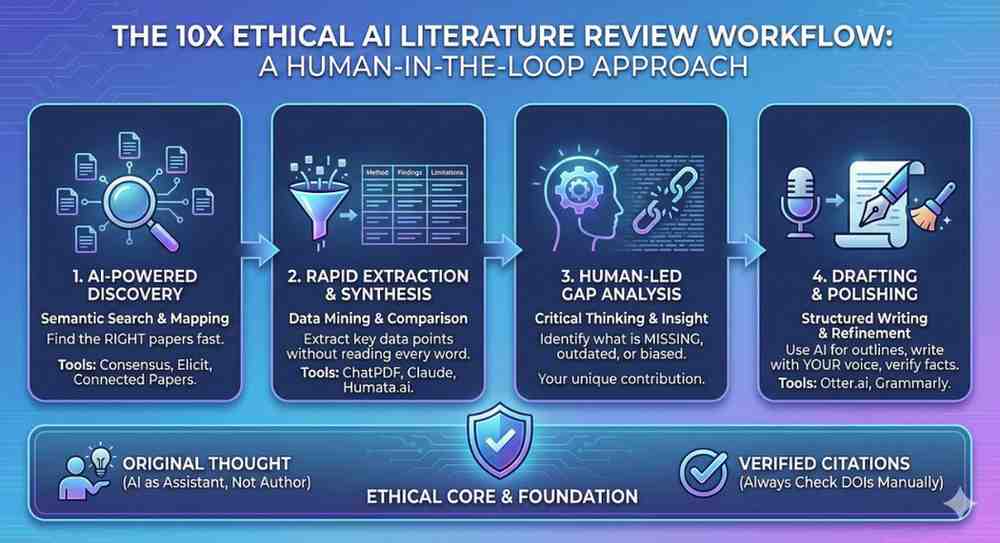
So, how do you write a literature review ethically using AI tools with 10x speed? It’s not about letting a chatbot write the paper for you. It’s about building an “AI-augmented workflow” where the machine handles the heavy lifting of data extraction while you handle the high-level critical analysis.
Here is how you master the new way of academic writing.
Why the "Old Way" of Writing Lit Reviews is Dying
The traditional method—searching, reading the full text, taking manual notes, and then drafting—is inherently linear. It’s also incredibly prone to human error. You miss a key citation because you were tired at 2:00 AM. You misinterpret a methodology because you’re skimming.
Using AI isn’t “cheating”; it’s the evolution of the research process. If you used a calculator in a math exam 50 years ago, it was a scandal. Today, it’s a requirement. The goal is to move from being a “data collector” to a “knowledge curator.”
1. The Ethical Foundations: The "Human-in-the-Loop" Framework
Before we touch a single tool, let’s address the elephant in the room: ethics.
Academic integrity rests on two pillars: originality of thought and accuracy of attribution. AI can hallucinate citations and misrepresent data. To write ethically, you must adopt the “Human-in-the-Loop” framework.
- AI for Synthesis, Not Creation: Use AI to summarize and find patterns. Use your brain to draw conclusions and build the argument.
- Verification is Mandatory: Never trust an AI-generated citation without checking the DOI (Digital Object Identifier) yourself.
- Transparency: If your institution requires it, disclose your use of AI tools in your methodology section.
2. Phase One: AI-Powered Discovery (The 10x Speed Jump)
The longest part of a lit review is finding the right papers. Google Scholar is great, but it’s a blunt instrument. To move 10x faster, you need semantic search tools.
Semantic Search vs. Keyword Search
Standard search engines look for specific words. Semantic AI tools (like Consensus, Elicit, or SciSpace) look for meaning.
- Ask a Research Question: Instead of typing “impact of remote work on productivity,” ask “Does remote work decrease team cohesion in software engineering?”
- Filter by Rigor: Use tools that allow you to filter for peer-reviewed journals, specific h-index ranges, or sample sizes.
- The “Snowball” Effect: Use AI to identify “Seed Papers”—the foundational works in your field—and then use tools like Connected Papers to visualize the citation map.
Pro Tip: Don’t just look for papers that agree with you. Ask the AI to “Find papers that contradict the prevailing theory on X.” This builds a much stronger, more balanced literature review.
3. Phase Two: Rapid Extraction and Synthesis
Once you have your stack of 30–50 papers, the “reading” begins. This is where most researchers get bogged down.
Using AI as your Research Assistant
Instead of reading every word of every paper, use PDF AI analyzers (like ChatPDF or Humata.ai) to extract specific data points. Create a spreadsheet with the following columns:
- Author/Year
- Core Argument
- Methodology
- Key Findings
- Limitations (Crucial for finding “gaps” in literature)
The 10x Strategy: Upload five papers at once to a tool like Claude 3.5 Sonnet (which has a huge context window) and prompt: “Compare and contrast the methodologies used in these five papers. Highlight the most significant differences in their findings regarding [Variable X].”
4. Identifying the "Gap": Where Your Brain Takes Over
AI is excellent at summarizing what is there. It is significantly less capable of identifying what is missing. This is your time to shine.
A literature review isn’t just a summary; it’s an argument for why your current research needs to exist. As you look at your AI-generated summaries, ask yourself:
- Are these studies outdated?
- Is there a geographic bias (e.g., all studies were done in the US)?
- Did they ignore a specific demographic?
- Is there a conflict in the results that needs resolving?
This “Gap Analysis” is the heart of your review. If you let AI write this part, it will sound generic. If you write it yourself based on the AI’s organization, it will sound brilliant.
5. Drafting with AI without Losing Your Voice
Now we get to the actual writing. The goal is to avoid the “AI voice”—that overly formal, repetitive, “In conclusion, it is important to note…” style.
The Reverse Outline Method
Speak your thoughts: Use a voice-to-text tool (like Otter.ai or Whisper) to dictate your main findings. “Paper A says this, but Paper B disagrees because of their sample size…”
Feed the transcript to AI: Ask the AI to organize your spoken thoughts into a formal academic outline.
Drafting: Use the AI to draft paragraphs based strictly on your notes.
- Bad Prompt: “Write a lit review about social media and mental health.”
- Good Prompt: “Using the summaries provided, write a 300-word section discussing the transition from ‘passive’ to ‘active’ social media use. Ensure you cite Smith (2022) and Jones (2023) and highlight the tension between their findings.”
6. Avoiding Common Pitfalls: The "Uncanny Valley" of Research
To maintain high ethical standards and ensure your work is 100% human-quality, avoid these three traps:
Trap 1: The Hallucination
AI tools love to be helpful, even if they have to lie to do it. They might invent a perfect study that supports your thesis.
- The Fix: Every time an AI mentions a fact, search the specific title in a database to ensure it exists.
Trap 2: The “Linguistic Fingerprint”
AI tends to use specific words like delve, testament, landscape, multifaceted, and tailored.
- The Fix: Use a “Search and Replace” mindset. If you see these words, swap them for more precise, academic alternatives. Better yet, read your work aloud. If it sounds like something a robot would say, rewrite it.
Trap 3: Over-reliance
If you don’t understand the papers you’re citing, it will show during your defense or peer review.
- The Fix: Use AI to explain complex concepts to you first. Ask: “Explain this statistical model like I’m a first-year grad student.” Once you understand it, you can write about it with authority.
7. The Ethical AI Toolkit: A Comparison
Tool Category | Recommended Apps | Best For… |
Discovery | Consensus, Elicit | Finding evidence-based answers and verified papers. |
Mapping | Connected Papers, Litmaps | Visualizing how different authors cite each other. |
Extraction | SciSpace, ChatPDF | Pulling data out of dense PDFs without reading every page. |
Drafting/Polishing | Claude 3.5, Grammarly | Structuring your thoughts and fixing tone. |
Citations | Zotero, Mendeley | Managing your library (Essential for ethical attribution). |
FAQs: How to Write a Literature Review Ethically Using AI Tools
Is using AI for a literature review considered plagiarism?
Using AI to help you understand and organize research is generally not plagiarism, provided you are the one making the intellectual connections and you cite the original sources. However, passing off AI-generated text as your own writing is a violation of most academic integrity policies.
Can AI correctly format my citations?
Mostly, yes. But tools like Zotero are much more reliable for the final formatting. AI can help you convert a list of links into a specific style (like APA 7th), but you should always do a final manual check.
How much time can I actually save?
A traditional literature review for a dissertation can take 3–6 months. With a optimized AI workflow, you can complete the synthesis and first draft in 2–3 weeks without sacrificing quality. That is the “10x speed” in action.
Will journals reject my paper if they detect AI?
Many journals now use AI detectors. These detectors are notoriously unreliable (producing many false positives), but the best way to avoid issues is to ensure the final prose is yours. Use AI for the “scaffolding,” but do the “brickwork” yourself.
Summary: The New Standard of Excellence
Learning how to write a literature review ethically using AI tools with 10x speed is about leverage. You are leveraging the processing power of machines to free up your human brain for what it does best: critical thinking, nuance, and creative synthesis.
The most successful researchers of the next decade won’t be those who avoid AI, but those who use it with the highest degree of skepticism and the sharpest ethical boundaries.
By following this workflow—semantic discovery, AI-assisted extraction, human gap analysis, and structured drafting—you aren’t just writing faster. You’re writing better. You’re seeing connections that a manual search would have missed and building a foundation for your research that is both broad and deep.
If you want to understand how AI tools can help you in writing literature review, you will love these courses that are meant for researchers like you : https://thephdcoaches.com/courses/.

About Dr. Tripti Chopra
Dr. Chopra is the founder and editor of thephdcoaches.blogs and Thephdcoaches Learn more about her here and connect with her on Instagram, Facebook and LinkedIn.
Our Featured Courses

Explore Our Courses
Empowering Scholars and Academics to Achieve Excellence Through Personalized Support and Innovative Resources
Our Featured E-Products

Explore Our Products
Empowering researchers with expert tools and personalized resources to achieve academic success.

Leave a Reply