

The Evolution of the Literature Review: From Manual Mastery to AI-Driven Speed
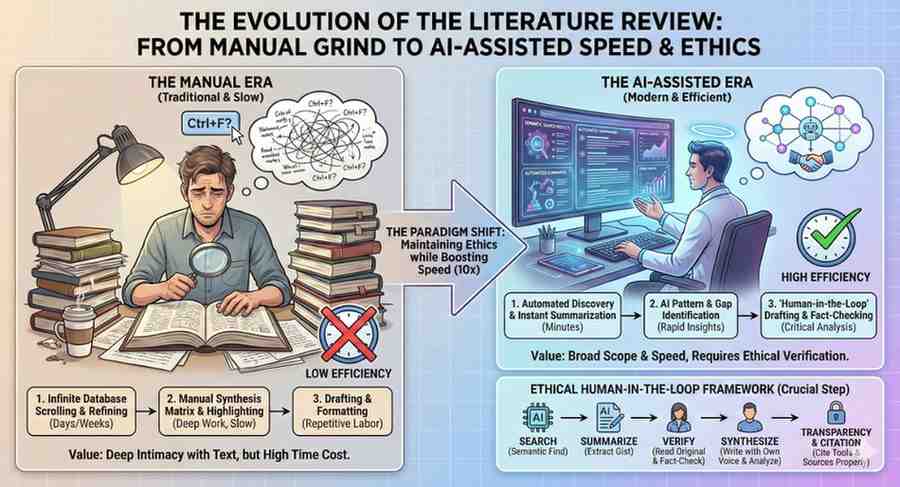
The literature review has always been the ultimate test of a researcher’s grit. It’s that grueling phase where you’re buried under a mountain of PDFs, caffeinated to the gills, trying to synthesize decades of thought into something coherent.
But things have changed. If you’re wondering how to write a literature review ethically without AI tools and now with using AI tools with 10x speed, you’re standing at the intersection of a massive shift in academia and professional writing.
We’ve moved from the era of “Ctrl+F” and highlighters to an era where a machine can summarize a 50-page paper in seconds. But speed shouldn’t come at the cost of integrity.
Whether you’re a PhD student, a professional researcher, or a content strategist, understanding this transition is key to staying relevant without losing your soul—or your credibility—to an algorithm.
The Old Guard: How We Used to Write Literature Reviews (The "Manual" Way)
Before the AI boom, writing a literature review was a test of endurance. It wasn’t just about reading; it was about internalizing.
The Search and Sift Phase
Back then, we lived in databases like JSTOR, PubMed, or Google Scholar. We’d spend days just refining search strings. You’d download 100 papers, realize 70 weren’t relevant, and start over.
The Synthesis Matrix
Most of us used a “Synthesis Matrix”—usually a giant Excel spreadsheet. You’d have columns for “Author,” “Methodology,” “Key Findings,” and “Gaps.” You had to read every word, extract the data manually, and hope you didn’t miss a nuance that would come back to haunt you during peer review.
The “Deep Work” Requirement
Writing a literature review manually required weeks of uninterrupted “deep work.” It was slow, painful, and often repetitive. But it had one massive advantage: Intimacy. By the time you finished, you didn’t just know the facts; you knew the “voice” of the field. You understood the subtle disagreements between researchers that a surface-level summary might miss.
Why the "Slow Way" Still Matters for Ethics
You might be thinking, “If I can do it 10x faster now, why bother with the old way?”
The answer is Ethical Ownership. When you do the manual labor, the connections you make are truly yours. You aren’t just regurgitating data; you’re forming a unique perspective. Ethics in research isn’t just about avoiding plagiarism; it’s about the honest representation of existing ideas.
If you don’t understand the foundation, you can’t ethically build the house.
The Paradigm Shift: Writing a Literature Review with AI Tools at 10x Speed
Fast forward to today. We have tools like Elicit, Consensus, Scite.ai, and even advanced LLMs like Claude or GPT-4o. The process that once took three months can now be condensed into three weeks—or even three days.
Here is how the workflow has evolved to achieve that 10x speed boost while maintaining high standards.
1. Automated Discovery (Goodbye, Infinite Scrolling)
Instead of guessing keywords, AI-powered discovery tools use semantic search. You can ask a natural language question like, “What are the psychological impacts of remote work on Gen Z?” and the AI finds papers based on meaning, not just keyword matches.
2. Instant Summarization and Extraction
This is where the real speed comes in. Tools can now extract findings across multiple papers simultaneously. Instead of reading ten papers to find their methodology, you can prompt an AI to create a comparison table of those ten papers in seconds.
3. Identifying Trends and Gaps
AI is incredibly good at pattern recognition. It can scan 200 abstracts and tell you, “Most studies focus on Western populations; there is a significant lack of data regarding the Global South.” Finding that “gap” used to take weeks of synthesis. Now, it’s a starting point.
How to Write a Literature Review Ethically with AI Tools
Using AI doesn’t make you a “cheater.” It makes you an efficient pilot of information. However, there is a right way and a wrong way to do it. If you want to use AI tools with 10x speed without compromising your ethics, follow this framework.
The “Human-in-the-Loop” Framework
Phase | What the AI Does | What the Human MUST Do |
Search | Finds relevant papers via semantic search. | Verify the source credibility and impact factor. |
Summarization | Provides a 200-word gist of the paper. | Read the “Results” and “Discussion” sections to ensure the AI didn’t hallucinate. |
Drafting | Organizes thoughts into a logical structure. | Rewrite the content in your own voice and add critical analysis. |
Citing | Formats citations in APA, MLA, etc. | Double-check every single link and page number. |
Rule #1: Never Copy-Paste AI Output
AI-generated text is often “fluffy” and generic. It uses words like “groundbreaking” or “meticulous” too often. Ethically, you should use AI to generate the outline and the data points, but the actual prose should come from your brain.
Rule #2: Fact-Check Everything
AI “hallucinates.” It might tell you that Smith (2022) said XYZ when Smith actually said the exact opposite. If you cite a hallucination, your reputation is toast. Always go back to the original PDF to verify “the big claims.”
Rule #3: Disclosure
Depending on your institution or publication, you may need to disclose that AI was used for literature mapping or drafting assistance. Transparency is the highest form of ethics.
Common Mistakes When Using AI for Literature Reviews
Even the smartest researchers trip up when they first start using these tools. Avoid these pitfalls:
- Over-reliance on Abstracts: AI often summarizes the abstract, not the full paper. The abstract is the “trailer,” but the “movie” (the full text) often contains the nuances and limitations you need for a good review.
- Ignoring the “Gray Literature”: AI tools are great at finding published journals but often miss conference papers, government reports, or niche white papers. Don’t let the tool narrow your vision.
- The “Robotic Tone” Trap: If your literature review reads like a list of summaries (“Author A said this. Author B said that.”), it’s a bad review. A good review synthesizes. It says, “While Author A and B agree on X, they fundamentally disagree on the cause, which suggests a need for further study.”
Expert Tips for 10x Productivity
If you want to maximize your speed without losing quality, try these advanced tactics:
- Use AI for “Clustering”: Upload 50 PDFs to a tool like NotebookLM or a custom GPT and ask it to “Group these papers by theoretical framework.” This saves you days of sorting.
- Reverse Search: Find one “seed paper” that is perfect for your topic. Use a tool like ResearchRabbit or Connected Papers to find everything else linked to it.
- The “Explain Like I’m 5” Prompt: If you’re reading a dense, jargon-heavy paper, ask an AI to explain the core methodology in simple terms. This helps you grasp the concept faster before you dive into the technical details.
Myths vs. Facts
Myth: AI will replace the need for researchers to read papers.
Fact: AI allows researchers to be more selective about which papers they spend time reading deeply.
Myth: Using AI is the same as plagiarism.
Fact: Plagiarism is taking credit for someone else’s ideas or words. Using AI to organize your own research process is a productivity method, provided you cite the original human authors.
Myth: AI tools are 100% accurate.
Fact: AI is a statistical model, not a database of truth. It predicts the next word; it doesn’t “know” the facts.
Frequently Asked Questions (FAQs)
Can I use ChatGPT to write my entire literature review?
You shouldn’t. ChatGPT is excellent for brainstorming and outlining, but it lacks the deep, specialized knowledge of your specific field. Writing an entire review with it often results in shallow, repetitive content that won’t pass a rigorous peer review.
What are the best AI tools for literature reviews in 2026?
Currently, tools like Elicit (for data extraction), Consensus (for finding evidence-based answers), and Zotero (with AI plugins for citation management) are the gold standard.
How do I cite AI-assisted research?
Most styles (APA, Chicago) now have specific guidelines for AI. Generally, you cite the tool in your methodology or acknowledgments section if it significantly contributed to the data analysis or drafting.
The Future of Scholarly Writing
We aren’t going back to the days of manual-only research. The genie is out of the bottle. The goal now is to find the “Goldilocks Zone”—using AI tools with 10x speed to handle the grunt work, while keeping the human brain in charge of the critical thinking.
The most successful writers of the next decade won’t be the ones who avoid AI, nor will they be the ones who let AI do everything. They will be the ones who use these tools to clear the clutter, allowing them to focus on what really matters: contributing new, meaningful ideas to the world.
Learning how to write a literature review ethically without AI tools and now with using AI tools with 10x speed isn’t just a career hack—it’s the new standard for excellence in the digital age.
If you want to understand how AI tools can help you in writing literature review, you will love these courses that are meant for researchers like you : https://thephdcoaches.com/courses/.

About Dr. Tripti Chopra
Dr. Chopra is the founder and editor of thephdcoaches.blogs and Thephdcoaches Learn more about her here and connect with her on Instagram, Facebook and LinkedIn.
Our Featured Courses

Explore Our Courses
Empowering Scholars and Academics to Achieve Excellence Through Personalized Support and Innovative Resources
Our Featured E-Products

Explore Our Products
Empowering researchers with expert tools and personalized resources to achieve academic success.

Leave a Reply